Once upon a time, AI slop meant weird hands and strange facial expressions. It’s a term that originated in the image generation community, as far as I recall. Only more recently has it been applied to text. ChatGPT’s overuse of emojis and cooking metaphors wasn’t called “slop” on arrival.
But recently things have come to a head. The proliferation of text slop has become unbearable, especially on social media sites like Reddit and LinkedIn. What’s even more unbearable is the number of people who don’t seem to notice. The slop cannons, in other words. And it’s metastasizing. Now we have website slop: all caps eyebrows, primary & secondary CTAs right next to each other, and a headline with the important part italicized. We have video slop: overly punchy rhythms, pill shaped buttons, generic soundtracks, and strikethrough animations. And of course we still have text slop. Mountains and mountains of it. The load-bearing thing that everyone is missing.
But I’ve come to realize that slop is actually… brilliant? Despite its flaws, “slop” is a perfectly formatted, impeccably phrased research report that would blow away any McKinsey client. “Slop” is a highly functional website that converts like crazy and would’ve taken weeks to make just 2 years ago. “Slop” can teach me any 101 topic in the world in a customized podcast or article in minutes.
So, face it. You’ve got slop envy. Claude is a brilliant know-it-all with some frustrating verbal tics, and “slop” is a derogatory word for a level of polish most of us would labor to achieve.
As an AI engineer, I work with AI-generated text constantly, both from coding agents that inform me that “that narrows the fix to the seam between the two” and from the many sophisticated text generation pipelines I run. Of all my coworkers, I’ve become the “nose” for slop. The brain rot is an occupational hazard.
I’ve noticed a lot of people fundamentally misunderstand what slop is. Most people think that slop just means “text written by AI”. But not all AI text is slop. It really depends on the domain and the amount of human collaboration. You simply don’t notice high quality AI text. Because it’s not slop.
Slop is just overused words & patterns. It’s a collection of verbal tics. Fable 5 & GPT 5.6 use some words and phrases 20, 30, up to 40 times more often than humans (and other LLMs). They like to use language that builds hype and tension, like negations and intensifiers (e.g. “every”, “the real”, “exactly”).
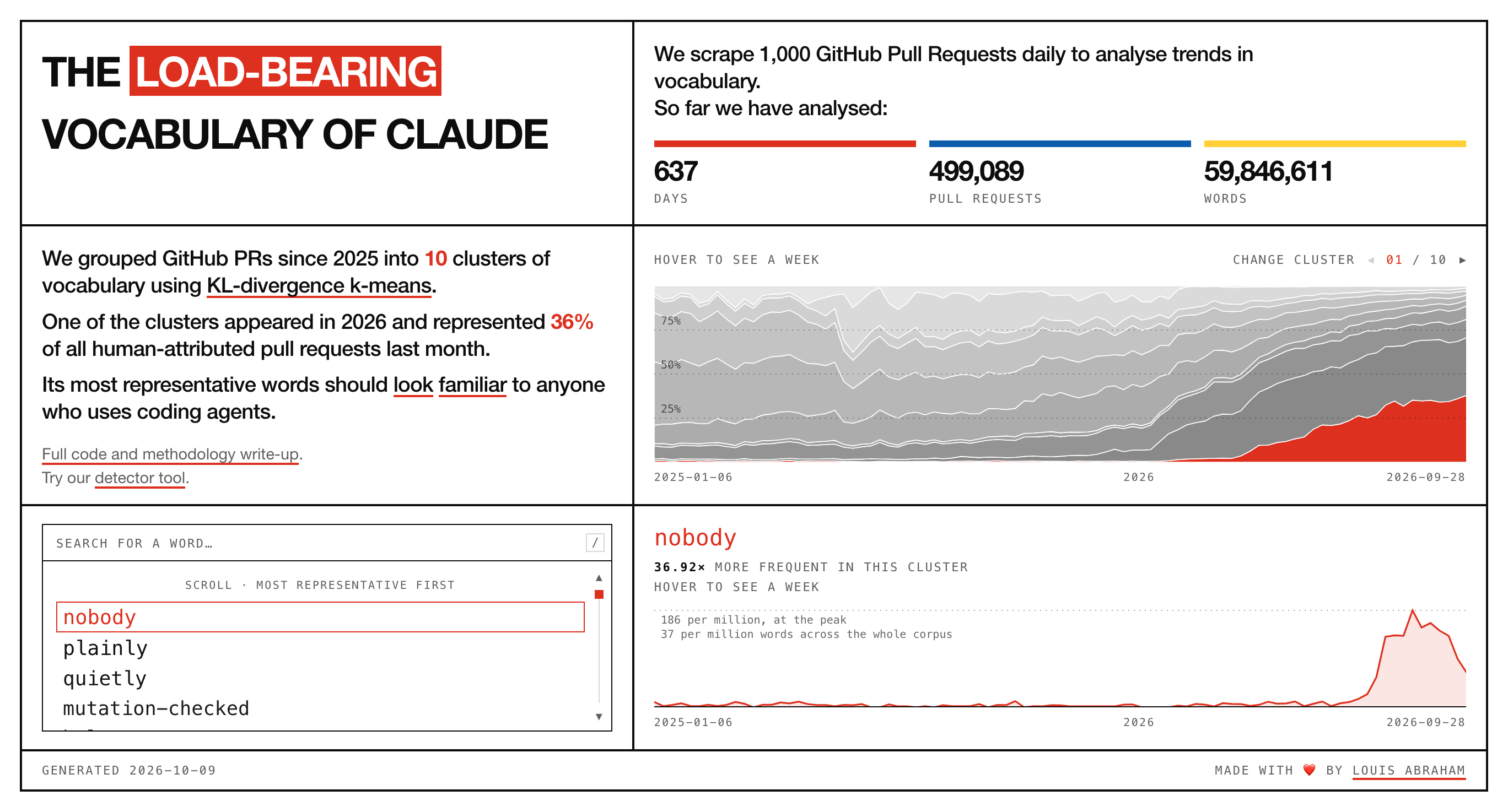
The Load-bearing Vocabulary of Claude is a great resource for getting familiar with slopwords. Check out the screenshot below, from this week’s scrape of GitHub. “Nobody” is 36.92x more common in the Claude cluster compared with everything else on GitHub (and probably much more common than what a human would write, since I’m guessing most PRs these days are written by agents).
The anti-slop secret everyone is missing is that overused words & patterns can be removed. Just scraping out about 30 words, removing “x, y, and z” triplets, and banning “not x but y” type negation patterns instantly humanizes most text by 80%+. Give it a try. Just stick that in your prompt. Grab the top 30 slopwords from the repo linked above. Ask your agent to do it. I promise you’ll notice a big difference.
Most people seem to have forgotten that text slop is kinda recent. In chatting with coworkers, I’ve noticed that many people recall Claude 3.5 Sonnet and Claude Opus 4 as the golden age of LLM writing. (Claude 3.5 Sonnet was my personal favorite model.) If you read text from that era, it sounds nothing like what you’d call slop now. Here’s an excerpt from a sci-fi story Claude 3.5 Sonnet wrote for EQBench:
Maze leads me through a maze (ha) of back alleys to a boarded-up building. She disappears through a gap in the plywood, and I follow her up a fire escape to the third floor. The space inside is surprisingly clean - some mattresses on the floor, milk crates serving as furniture, battery-powered lanterns scattered around.
Not one “load-bearing” in sight. And the text is, like, normal!
I recently discovered the Magnum series of models by Anthracite on Hugging Face. They’re Qwen models fine-tuned to sound like Claude 3 Sonnet and Opus. I got a complete blast from the past when it used a chef in the kitchen metaphor to explain customer segmentation. The incessant emojis felt kind of quaint. But, ya know, the writing is kinda bad, and overall it feels very nonthreatening, like nobody would use this for serious work.
Everyone hates slop, but it’s really because we all resent the idea that the person on the other end of this document or program or message or whatever didn’t take the time to write it themselves, considering I’m taking the time to read it. It’s really because we wish we could write as prolifically, as effortlessly as an LLM. It’s really because we all worry that AI is going to take our jobs.
If you can master those feelings and look past slop, you’ll get enormous benefits. You should realize that you have access to world class research, coding, education, and more, to extremely cheap and fast intelligence, for just $20 a month. For the price of a few coffees or a burrito you can get a complete audit of your financial health, a custom website deployed for your business, a slide deck explaining your research to your boss, and so so so much more.
I recently wanted to learn more about procedural generation. I asked Claude to deeply research this topic and put together an HTML course on it with extensive quotes and cited research. That course was incredibly valuable to me. While it was nowhere near as good as an expert human instructor, and while it definitely contained a ton of slopwords, I learned a lot from it and have since shared it with several coworkers who are working on similar problems. (Course-as-HTML is a fantastic prompting technique btw.)
Slop is a bit like capitalism. You can be paralyzed by how much it sucks to be part of it, or you can embrace the parts of it that do align with your values while accepting the things you cannot change.
This version of slop will pass. Someday we’ll feel nostalgic for it. In the meantime, we’ll have to sit with the discomfort, and honestly, there’s something beautiful about that. 😉